
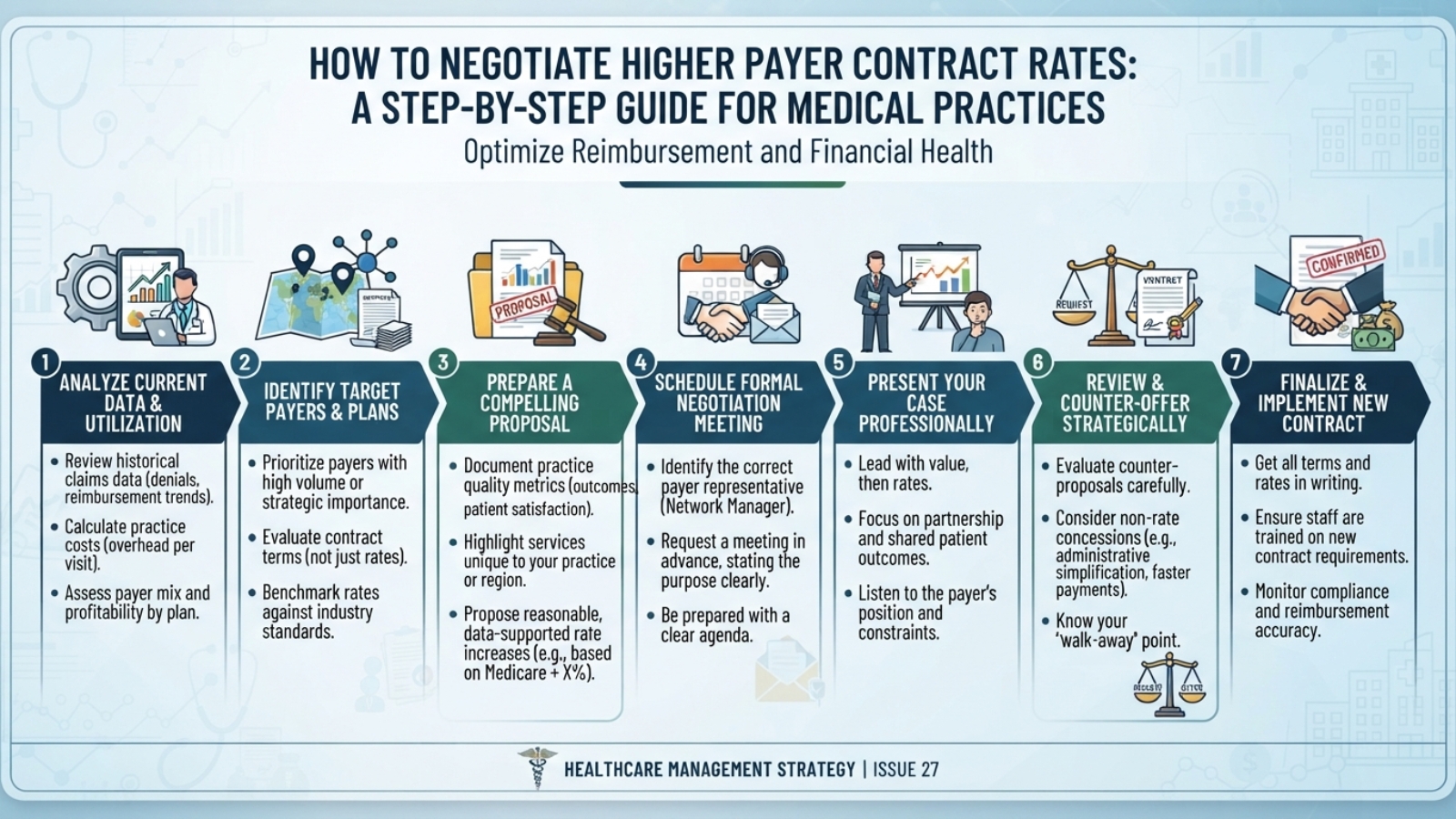
Most payer contracts renew quietly year after year with reimbursement rates that barely move, not because payers refuse better terms, but because most practices never formally ask. Rates on major commercial contracts often rise only slightly annually while a practice’s costs — staff, supplies, rent — climb well above that. A meaningful rate increase across a practice’s top payer contracts can represent real annual revenue without adding a single additional patient. This guide walks through exactly how to prepare for and run that negotiation.
Step 1: Know Your Contract Calendar
Payer contract negotiation works best when it starts 30 to 60 days before a renewal date, not after a new offer letter has already arrived. Waiting until a payer initiates the conversation puts the practice on the payer’s timeline and terms rather than the practice’s own.
Pull every active payer contract and note:
- Renewal or auto-renewal dates
- Notice periods required to open renegotiation (often 60–90 days)
- Termination clauses and their notice requirements
- Any evergreen or automatic-renewal language that could lock in current rates for another cycle if missed
A practice with contracts renewing on different dates throughout the year should build this into a standing calendar rather than reacting contract by contract.
Step 2: Build Your Data Case Before You Ask
Payers respond to numbers, not general requests for “better rates.” Before requesting a conversation, assemble:
- Your top CPT codes by volume, benchmarked against your actual costs to deliver each service and against the current Medicare fee schedule as a reference point
- Reimbursement history per payer, showing what’s actually been paid versus what the contract states — discrepancies here are common and worth surfacing on their own
- Patient volume and payer mix, since a payer sending a high volume of patients to your practice has more reason to keep you satisfied and in-network
- Cost trend documentation — rent, labor, and supply cost increases since the contract was last negotiated, framed in concrete percentage terms rather than general statements
- Quality and outcomes data, where available — readmission rates, patient satisfaction scores, or other value-based metrics increasingly matter to payers evaluating network performance
The stronger and more specific this data package, the harder it is for a payer to respond with a generic decline.
Step 3: Review the Full Contract, Not Just the Rate Sheet
A higher headline rate paired with unfavorable contract language can leave a practice worse off than a slightly lower rate with better terms. Review:
- Timely filing limits — how long you have to submit claims before automatic denial
- Retroactive claim adjustment clauses — whether a payer can claw back payments after the fact, and under what circumstances
- Unilateral amendment provisions — language that lets a payer change contract terms without requiring your active consent
- Fee schedule update mechanisms — whether rates adjust automatically with any published fee schedule or require separate negotiation
Flagging problematic language during a rate negotiation is often easier than trying to renegotiate it in isolation later.
Step 4: Set a Specific, Defensible Target
“Better rates” is not a negotiating position. A specific, benchmarked target is. Rather than proposing a broad, uniform increase across every code, many practices find more success narrowing the ask: accepting a smaller across-the-board adjustment while pushing harder on a handful of high-volume, high-value codes where the data case is strongest. That kind of structured, partial ask tends to read as more reasonable to a payer’s negotiating team than an across-the-board demand, while still capturing meaningful revenue where it matters most.
Step 5: Identify Your Real Leverage
Before requesting a meeting, be honest about what leverage actually exists:
- Patient volume the payer would need to redirect to another provider if the relationship ended
- Specialty scarcity — a shortage of specialists in a given service line or region strengthens the practice’s position considerably
- Network adequacy requirements the payer may need to meet in your area, particularly relevant for behavioral health and other historically underpaid specialties facing parity enforcement scrutiny
- Quality performance that supports the payer’s own value-based contracting goals
Practices with genuine leverage should lead with it. Practices without much (a small, low-volume practice in a market with many providers) should focus the case more heavily on cost documentation and quality data instead.
Step 6: Request the Conversation in Writing, With a Clear Ask
A formal written request — not an informal call — starts the process on the record and typically triggers the payer’s internal contract review workflow. The request should specify what’s being asked for (a defined rate adjustment on specified codes, or specific contract language changes) rather than an open-ended request to “discuss the contract.”
Step 7: Negotiate the Full Package, Not Just the First Offer
Initial counteroffers from payers are rarely final. Practices that accept the first response, positive or not, typically leave value on the table. Useful negotiation habits include:
- Waiting until final contract terms are fully defined before agreeing to anything, rather than accepting a verbal or partial commitment early
- Treating rate, terms, and effective date as a connected package rather than negotiating rate in isolation
- Documenting every verbal commitment in writing before considering the negotiation closed
Common Mistakes That Undermine Payer Negotiations
- Negotiating without payer-specific reimbursement data, relying on general impressions rather than actual payment history
- Requesting a uniform, unstructured rate increase across all codes instead of a targeted ask on high-value codes
- Accepting the first counteroffer without a documented back-and-forth
- Overlooking contract language in favor of focusing only on the headline rate
- Missing the renegotiation window because the contract’s notice period wasn’t tracked in advance
- Assuming Medicare or Medicaid rates are negotiable — these are generally set by statute and fee schedule, unlike most commercial contracts
What Realistic Outcomes Look Like
Not every negotiation results in a large increase, and framing expectations accurately matters. A realistic, well-prepared negotiation more often produces a modest but real increase on a targeted set of high-volume codes, improved contract language around claims timing or retroactive adjustments, or both — rather than a broad, sweeping rate change across the entire fee schedule. Consistency across renewal cycles, rather than a single dramatic win, is what compounds into meaningful long-term revenue improvement.
When to Bring In Dedicated Contracting Support
Payer negotiation is a specialized, ongoing discipline — tracking renewal windows across dozens of contracts, building payer-specific data packages, and understanding which levers matter to which payer type takes sustained attention that’s easy to deprioritize against day-to-day patient care demands. Red Sea Consulting’s contracting and negotiation team reviews and revises payer contracts on behalf of healthcare providers nationwide, aligning negotiated terms with each practice’s actual business goals rather than accepting standard payer templates. Combined with ongoing research and development tracking of payer policy changes, that means practices negotiate from current market context rather than outdated assumptions.
Have a renewal date coming up? Book a consultation before the notice window closes.
FAQ: Negotiating Payer Contract Rates
When is the best time to negotiate a payer contract? Generally 30 to 60 days before the contract’s renewal date, and before any auto-renewal notice deadline passes — waiting for the payer to initiate the conversation puts the practice at a disadvantage.
Can Medicare and Medicaid rates be negotiated? No. Medicare and Medicaid reimbursement rates are set by statute and published fee schedules and are not subject to individual practice negotiation. Negotiation applies to commercial payer contracts.
What data should I bring to a payer negotiation? Reimbursement history by CPT code, current cost-to-deliver data, patient volume and payer mix, documented cost increases since the last negotiation, and any available quality or outcomes metrics.
Should I negotiate every code or focus on specific ones? A targeted approach — a modest across-the-board request combined with a stronger push on your highest-volume, highest-value codes — is often more successful than requesting a large uniform increase on every code.
What if a payer refuses to negotiate at all? Some payers, particularly those with strong regional market share, negotiate less readily. In those cases, focus on contract language improvements (timely filing, retroactive adjustment limits) even if the rate itself doesn’t move, and revisit rate negotiation at the next renewal window with updated data.
How much can a practice realistically gain from renegotiating? Outcomes vary significantly by specialty, market, and leverage, and no specific result can be guaranteed. Practices with strong data and genuine leverage on high-volume codes tend to see more meaningful movement than broad, unfocused requests.
Do I need a lawyer to negotiate a payer contract? Not necessarily for the negotiation itself, but legal review of final contract language — particularly around liability, termination, and amendment clauses — is worth considering before signing, especially for larger group agreements.
Best betting platform I have used in Mexico so far. The odds are competitive and the site loads quickly even on mobile. Cheers to mxbet44 for the top notch service.