
negotiate payer contract rates

How to Negotiate Higher Payer Contract Rates: A Step-by-Step Guide for Medical Practices

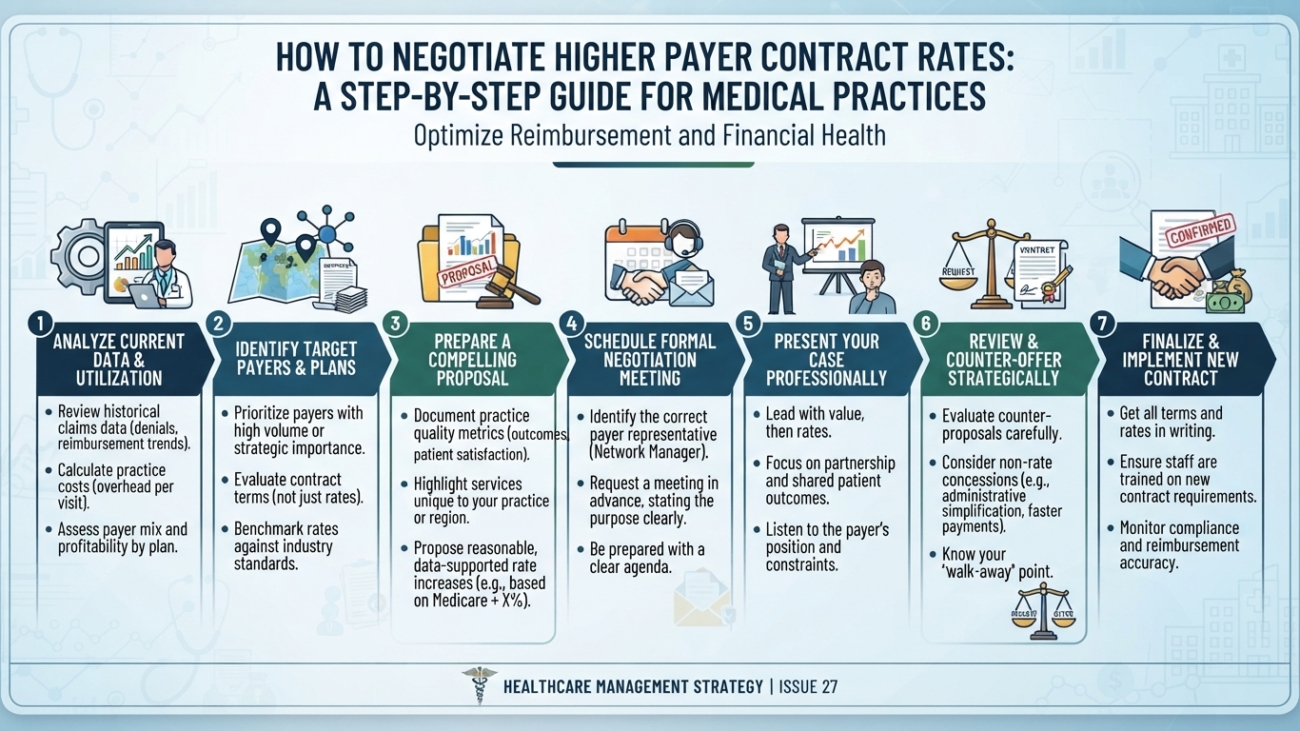
Most payer contracts renew quietly year after year with reimbursement rates that barely move, not because payers refuse better terms, but because most practices never formally ask. Rates on major commercial contracts often rise only slightly annually while a practice’s costs — staff, supplies, rent — climb well above that. A meaningful rate increase across a practice’s top payer contracts can represent real annual revenue without adding a single additional patient. This guide walks through exactly how to prepare for and run that negotiation.

Step 1: Know Your Contract Calendar

Payer contract negotiation works best when it starts 30 to 60 days before a renewal date, not after a new offer letter has already arrived. Waiting until a payer initiates the conversation puts the practice on the payer’s timeline and terms rather than the practice’s own.

Pull every active payer contract and note:

  • Renewal or auto-renewal dates
  • Notice periods required to open renegotiation (often 60–90 days)
  • Termination clauses and their notice requirements
  • Any evergreen or automatic-renewal language that could lock in current rates for another cycle if missed

A practice with contracts renewing on different dates throughout the year should build this into a standing calendar rather than reacting contract by contract.

Step 2: Build Your Data Case Before You Ask

Payers respond to numbers, not general requests for “better rates.” Before requesting a conversation, assemble:

  • Your top CPT codes by volume, benchmarked against your actual costs to deliver each service and against the current Medicare fee schedule as a reference point
  • Reimbursement history per payer, showing what’s actually been paid versus what the contract states — discrepancies here are common and worth surfacing on their own
  • Patient volume and payer mix, since a payer sending a high volume of patients to your practice has more reason to keep you satisfied and in-network
  • Cost trend documentation — rent, labor, and supply cost increases since the contract was last negotiated, framed in concrete percentage terms rather than general statements
  • Quality and outcomes data, where available — readmission rates, patient satisfaction scores, or other value-based metrics increasingly matter to payers evaluating network performance

The stronger and more specific this data package, the harder it is for a payer to respond with a generic decline.

Step 3: Review the Full Contract, Not Just the Rate Sheet

A higher headline rate paired with unfavorable contract language can leave a practice worse off than a slightly lower rate with better terms. Review:

  • Timely filing limits — how long you have to submit claims before automatic denial
  • Retroactive claim adjustment clauses — whether a payer can claw back payments after the fact, and under what circumstances
  • Unilateral amendment provisions — language that lets a payer change contract terms without requiring your active consent
  • Fee schedule update mechanisms — whether rates adjust automatically with any published fee schedule or require separate negotiation

Flagging problematic language during a rate negotiation is often easier than trying to renegotiate it in isolation later.

Step 4: Set a Specific, Defensible Target

“Better rates” is not a negotiating position. A specific, benchmarked target is. Rather than proposing a broad, uniform increase across every code, many practices find more success narrowing the ask: accepting a smaller across-the-board adjustment while pushing harder on a handful of high-volume, high-value codes where the data case is strongest. That kind of structured, partial ask tends to read as more reasonable to a payer’s negotiating team than an across-the-board demand, while still capturing meaningful revenue where it matters most.

Step 5: Identify Your Real Leverage

Before requesting a meeting, be honest about what leverage actually exists:

  • Patient volume the payer would need to redirect to another provider if the relationship ended
  • Specialty scarcity — a shortage of specialists in a given service line or region strengthens the practice’s position considerably
  • Network adequacy requirements the payer may need to meet in your area, particularly relevant for behavioral health and other historically underpaid specialties facing parity enforcement scrutiny
  • Quality performance that supports the payer’s own value-based contracting goals

Practices with genuine leverage should lead with it. Practices without much (a small, low-volume practice in a market with many providers) should focus the case more heavily on cost documentation and quality data instead.

Step 6: Request the Conversation in Writing, With a Clear Ask

A formal written request — not an informal call — starts the process on the record and typically triggers the payer’s internal contract review workflow. The request should specify what’s being asked for (a defined rate adjustment on specified codes, or specific contract language changes) rather than an open-ended request to “discuss the contract.”

Step 7: Negotiate the Full Package, Not Just the First Offer

Initial counteroffers from payers are rarely final. Practices that accept the first response, positive or not, typically leave value on the table. Useful negotiation habits include:

  • Waiting until final contract terms are fully defined before agreeing to anything, rather than accepting a verbal or partial commitment early
  • Treating rate, terms, and effective date as a connected package rather than negotiating rate in isolation
  • Documenting every verbal commitment in writing before considering the negotiation closed

Common Mistakes That Undermine Payer Negotiations

  • Negotiating without payer-specific reimbursement data, relying on general impressions rather than actual payment history
  • Requesting a uniform, unstructured rate increase across all codes instead of a targeted ask on high-value codes
  • Accepting the first counteroffer without a documented back-and-forth
  • Overlooking contract language in favor of focusing only on the headline rate
  • Missing the renegotiation window because the contract’s notice period wasn’t tracked in advance
  • Assuming Medicare or Medicaid rates are negotiable — these are generally set by statute and fee schedule, unlike most commercial contracts

What Realistic Outcomes Look Like

Not every negotiation results in a large increase, and framing expectations accurately matters. A realistic, well-prepared negotiation more often produces a modest but real increase on a targeted set of high-volume codes, improved contract language around claims timing or retroactive adjustments, or both — rather than a broad, sweeping rate change across the entire fee schedule. Consistency across renewal cycles, rather than a single dramatic win, is what compounds into meaningful long-term revenue improvement.

When to Bring In Dedicated Contracting Support

Payer negotiation is a specialized, ongoing discipline — tracking renewal windows across dozens of contracts, building payer-specific data packages, and understanding which levers matter to which payer type takes sustained attention that’s easy to deprioritize against day-to-day patient care demands. Red Sea Consulting’s contracting and negotiation team reviews and revises payer contracts on behalf of healthcare providers nationwide, aligning negotiated terms with each practice’s actual business goals rather than accepting standard payer templates. Combined with ongoing research and development tracking of payer policy changes, that means practices negotiate from current market context rather than outdated assumptions.

Have a renewal date coming up? Book a consultation before the notice window closes.

FAQ: Negotiating Payer Contract Rates

When is the best time to negotiate a payer contract? Generally 30 to 60 days before the contract’s renewal date, and before any auto-renewal notice deadline passes — waiting for the payer to initiate the conversation puts the practice at a disadvantage.

Can Medicare and Medicaid rates be negotiated? No. Medicare and Medicaid reimbursement rates are set by statute and published fee schedules and are not subject to individual practice negotiation. Negotiation applies to commercial payer contracts.

What data should I bring to a payer negotiation? Reimbursement history by CPT code, current cost-to-deliver data, patient volume and payer mix, documented cost increases since the last negotiation, and any available quality or outcomes metrics.

Should I negotiate every code or focus on specific ones? A targeted approach — a modest across-the-board request combined with a stronger push on your highest-volume, highest-value codes — is often more successful than requesting a large uniform increase on every code.

What if a payer refuses to negotiate at all? Some payers, particularly those with strong regional market share, negotiate less readily. In those cases, focus on contract language improvements (timely filing, retroactive adjustment limits) even if the rate itself doesn’t move, and revisit rate negotiation at the next renewal window with updated data.

How much can a practice realistically gain from renegotiating? Outcomes vary significantly by specialty, market, and leverage, and no specific result can be guaranteed. Practices with strong data and genuine leverage on high-volume codes tend to see more meaningful movement than broad, unfocused requests.

Do I need a lawyer to negotiate a payer contract? Not necessarily for the negotiation itself, but legal review of final contract language — particularly around liability, termination, and amendment clauses — is worth considering before signing, especially for larger group agreements.
Provider Enrollment vs. Credentialing: What's the Difference (and Why Your Practice Needs Both)

Provider Enrollment vs. Credentialing: What’s the Difference (and Why Your Practice Needs Both)

A provider is credentialed. A provider is enrolled. A billing team says a claim was denied because “enrollment isn’t finished,” while the credentialing file shows the provider was approved months ago. If that combination of facts is confusing, it’s because credentialing and provider enrollment are two distinct processes that get used interchangeably in everyday conversation — and that confusion is exactly what causes preventable claim denials.

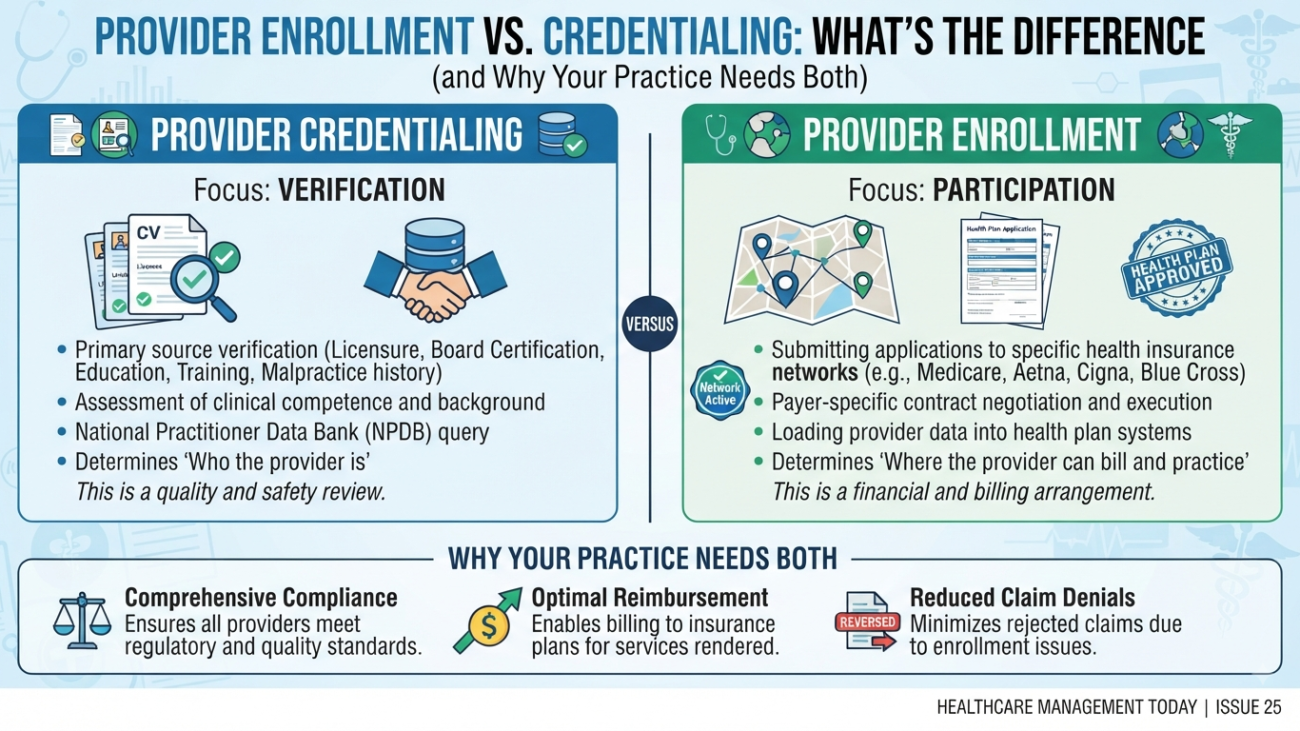
Here’s the direct answer: credentialing verifies who a provider is and whether they’re qualified to practice; enrollment is the administrative process of registering that provider with a specific payer’s billing system so claims can actually be paid. A provider can be fully credentialed and still be unable to bill because enrollment isn’t complete. This article walks through exactly where the line falls, how the two processes connect, and what happens when practices treat them as the same step.

Credentialing: Verifying Qualifications

Credentialing is a verification process. A payer’s credentialing committee (or a delegated credentialing entity) reviews a provider’s:

  • Education and training history
  • State medical license status and history
  • Board certifications
  • Malpractice insurance coverage and claims history
  • Work history, with any gaps explained
  • Sanctions, exclusions, or disciplinary actions
  • DEA registration, where applicable

The goal is a yes/no decision: does this provider meet the payer’s standards to participate in the network at all? Most commercial payers pull this data through a CAQH ProView profile, which centralizes the same core information for reuse across multiple payers rather than requiring a provider to submit it separately each time.

Credentialing answers the question: Is this provider qualified and in good standing?

Enrollment: Getting Added to the Billing System

Enrollment is what happens after — or sometimes alongside — credentialing. It’s the administrative step of registering a provider in a specific payer’s system so that claims submitted under that provider’s NPI are recognized, processed, and paid rather than automatically rejected.

The clearest example is Medicare. Medicare enrollment happens through PECOS — the Provider Enrollment, Chain and Ownership System — a CMS platform separate from any commercial credentialing process. Enrollment through PECOS uses CMS-855 forms specific to the situation:

  • CMS-855I — individual providers
  • CMS-855B — clinics, group practices, and other organizational suppliers
  • CMS-855R — reassignment of benefits (joining a group)

PECOS doesn’t evaluate whether a provider is clinically qualified — that’s what state licensure and, separately, credentialing establish. PECOS confirms identity, tax and ownership information, practice locations, and banking details so CMS knows exactly who is billing, under what tax ID, and where payments should go. An application can be submitted correctly and still be rejected over a mismatched detail as small as an NPI record that doesn’t match the legal name on file.

Enrollment answers the question: Is this provider correctly registered in this payer’s billing system?

How the Two Processes Actually Connect

CredentialingEnrollment
What it verifiesProvider qualifications, licensure, training, historyAdministrative billing registration
Who manages itPayer credentialing committees (commercial); state boardsCMS via PECOS (Medicare); state Medicaid agencies; payer enrollment teams
Primary data sourceCAQH ProView (commercial)CMS-855 forms; NPPES/NPI registry; state Medicaid portals
Typical timeline90–120 days (commercial)60–90 days (Medicare PECOS)
OutcomeApproved to participate in networkAble to bill and be reimbursed

For Medicare specifically, a provider generally needs both processes to align: credentialing-equivalent verification through licensure and training standards, and PECOS enrollment to actually bill. For commercial payers, credentialing and enrollment are sometimes handled by the same team in close sequence, which is part of why the two terms get blurred in daily use — but a credentialing approval and a fully loaded, billable enrollment record are still two separate outcomes, and a gap between them is a common, quiet cause of denied claims. For a full look at how long each stage of this process actually takes, see How Long Does Provider Credentialing Take?

Where the Confusion Causes Real Problems

The practical risk isn’t academic. When credentialing and enrollment are treated as the same step:

  • Claims get submitted before enrollment is actually complete, resulting in denials even though the provider was “approved” weeks earlier.
  • Data mismatches between the credentialing file and the enrollment application — a different practice address, a name variant, an NPI typo — trigger delays that could have been caught if the two processes were tracked together.
  • Revalidation deadlines get missed. Medicare enrollment requires periodic revalidation (generally every five years), which is separate from the CAQH 120-day attestation cycle and the payer’s own recredentialing schedule. Missing any one of these three clocks can quietly interrupt billing.
  • Group additions stall. When a new provider joins an existing group, reassignment of benefits (CMS-855R) has to be filed correctly alongside the individual enrollment — a step that’s easy to overlook if credentialing is treated as the finish line.

A Practical Way to Think About the Sequence

For most new providers, the realistic order looks like this:

  1. State licensure confirmed and active
  2. CAQH profile built and attested
  3. Credentialing submitted to and approved by relevant commercial payers
  4. Medicare enrollment submitted via PECOS (can run in parallel with commercial credentialing, not after it)
  5. Medicaid enrollment submitted to relevant state program(s)
  6. Contracting — rates and terms finalized once credentialing/enrollment clears, covered in more detail in our guide to negotiating payer contract rates
  7. Billing goes live only once enrollment records are fully loaded on the payer’s side, not simply once a credentialing decision letter arrives

Steps 3 and 4 can and should run concurrently rather than sequentially — one of the most common, avoidable sources of lost time is waiting to start Medicare enrollment until commercial credentialing is finished, when the two have no dependency on each other.

Why Practices Need Both, Managed Together

Treating credentialing and enrollment as one continuous, jointly tracked process — rather than two separate tasks handled by whoever has time — is what actually prevents the claim denials and billing gaps that show up months later, disconnected from their real cause. This is where dedicated business consulting for healthcare providers matters as much as the credentialing paperwork itself: getting the sequencing right the first time avoids a second round of corrections after a practice is already seeing patients.

Red Sea Consulting handles credentialing and enrollment as a coordinated process rather than disconnected paperwork, with dedicated account management tracking both sets of deadlines — CAQH attestation, payer credentialing status, and PECOS enrollment — so nothing falls into the gap between “approved” and “billable.”

Have a provider stuck between “approved” and “billable”? Book a consultation and we’ll find out exactly where the gap is.

FAQ: Provider Enrollment vs. Credentialing

Is provider enrollment the same as being in-network? Not exactly. Enrollment registers a provider in a payer’s billing system; being fully in-network also typically requires an executed contract at agreed rates. A provider can be enrolled and credentialed while contract terms are still being finalized.

Do I need to complete credentialing before starting Medicare enrollment? No — Medicare enrollment through PECOS and commercial payer credentialing are independent processes and can be submitted in parallel to save time.

What is PECOS used for? PECOS (Provider Enrollment, Chain, and Ownership System) is the CMS platform used to enroll, update, and revalidate Medicare provider and supplier records. It manages billing registration, not clinical credentialing.

How often does Medicare enrollment need to be revalidated? CMS generally requires revalidation on a set cycle, commonly around every five years, separate from CAQH’s 120-day attestation requirement and a commercial payer’s own recredentialing schedule.

Can a claim be denied even if a provider is credentialed? Yes. A common cause is a claim submitted before enrollment with that specific payer is fully processed and loaded, even though credentialing was approved.

What happens when a provider joins an existing group practice? In addition to standard credentialing, a reassignment of benefits form (CMS-855R for Medicare) generally needs to be filed so claims can be billed under the group’s tax ID rather than only the individual provider.

Who manages provider enrollment — the practice or the payer? The provider or practice submits and manages the enrollment application; the payer (or CMS, for Medicare) reviews and processes it. Responsibility for accuracy stays with the submitting provider or authorized official even when a third party assists.

how long does credentialing take

How Long Does Provider Credentialing Take? A Complete Timeline for Healthcare Practices

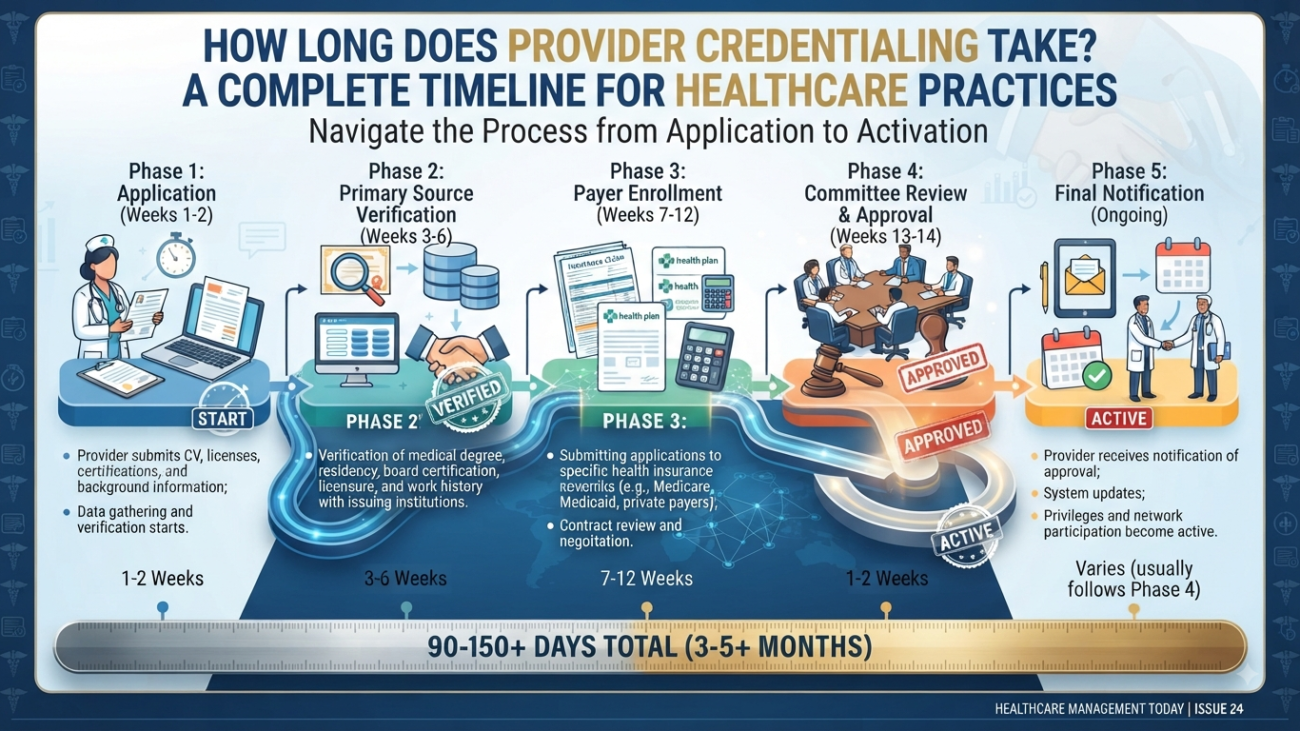
If you’re opening a new practice, hiring a provider, or adding a location, the question that determines everything else is simple: how long until this provider can actually see patients and get paid? The honest answer is that credentialing takes anywhere from 60 to 180 days depending on the payer, and treating it as a single, uniform process is the single biggest reason practices miss their planned launch dates.

This guide breaks down exactly how long each stage takes, why timelines differ so much between Medicare, Medicaid, and commercial payers, and what actually causes the delays that turn a 90-day estimate into a six-month wait.

What Is Credentialing, Exactly?

Credentialing is the verification process payers use to confirm that a provider is who they say they are — that their license is active, their education and training check out, their malpractice history is clean, and they meet the payer’s participation standards. It happens before a provider can be added to a payer’s network and before claims for that provider can be reimbursed.

Credentialing is not the same as contracting (negotiating the rates and terms once approved) or enrollment (the administrative step of being added to a payer’s billing system, most visible with Medicare’s PECOS system). The three are sequential and often confused, which is part of why timeline expectations get muddled. For a full breakdown of how enrollment and credentialing relate, see our companion article, Provider Enrollment vs. Credentialing: What’s the Difference.

The Credentialing Timeline, Stage by Stage

Stage 1: CAQH Profile Setup (1–3 hours of work, 3–10 business days to activate)

Most commercial payers pull provider data from CAQH ProView, a centralized data repository maintained by the Council for Affordable Quality Healthcare. Building a CAQH profile from scratch — entering education history, work history, licenses, malpractice coverage, and practice locations — typically takes a provider or credentialing staff member one to three focused hours, assuming documents are already gathered. Once submitted and attested, the profile itself is generally active within about a week.

The catch: a completed CAQH profile is a prerequisite for credentialing, not the credentialing decision itself. Payers still have to pull that data and run their own review.

Stage 2: Commercial Payer Credentialing (90–120 days)

Once a payer has access to a complete, attested CAQH profile, the credentialing committee review typically runs 90 to 120 days from submission to decision. This is the stage most people mean when they ask how long credentialing takes, and it’s also the stage most vulnerable to delay — a single missing document, an expired certificate, or a mismatch between the CAQH profile and the payer application can send an application back to the bottom of the queue.

Stage 3: Medicare Enrollment via PECOS (60–90 days)

Medicare enrollment runs through PECOS — the Provider Enrollment, Chain, and Ownership System — a separate process from commercial credentialing, submitted through CMS-855 forms specific to individuals, groups, or benefit reassignment. Processing generally takes 60 to 90 days from a complete submission, though the exact timeline depends on the Medicare Administrative Contractor (MAC) assigned to your region. Missing NPI details, ownership disclosures, or signature mismatches are common causes of “development letters” that restart the clock.

Stage 4: Medicaid Enrollment (30–120 days, highly state-dependent)

Medicaid enrollment is the least predictable stage because every state runs its own program, its own portal, and its own review standards. Some states process applications in as little as 30 days; others routinely take 120 days or more, particularly for out-of-state or newly licensed providers. If your practice operates in multiple states, plan for the slowest state in your footprint to set your realistic go-live date.

Stage 5: Payer-Specific Contracting

Being credentialed doesn’t automatically mean you’re in-network. Some payers credential and load a contract simultaneously; others require a separate contracting step once credentialing clears, which can add several more weeks before the provider is billable at negotiated rates. This is where many practices lose time they didn’t budget for — see our guide, How to Negotiate Higher Payer Contract Rates, for what that stage actually involves.

Realistic Total Timeline: What to Actually Plan For

Payer TypeTypical Processing TimeKey Dependency
Commercial (via CAQH)90–120 daysComplete, attested CAQH profile
Medicare (PECOS)60–90 daysAccurate CMS-855 application, NPI match
Medicaid30–120 daysState-specific, highly variable
Contracting (post-credentialing)2–8 additional weeksSeparate from credentialing in many cases

For a provider credentialing with a full mix of commercial, Medicare, and Medicaid payers, a 120-to-150-day runway from application submission to full in-network billing status is a realistic planning assumption — not the 30-day timeline sometimes advertised, and not the worst-case six-month horror story either, if the application is clean from the start.

Why Credentialing Takes Longer Than Expected: The Real Causes of Delay

Most delays aren’t about payer slowness. They’re about avoidable errors on the front end:

  • Incomplete CAQH profiles. A profile that’s unattested, missing a work history gap explanation, or lacking a required document gets flagged before a payer even begins substantive review.
  • Data mismatches. A provider’s name, NPI, or practice address that doesn’t match exactly across CAQH, the state license, and the payer application is one of the most common reasons applications stall.
  • Expired documents. DEA registrations, board certifications, and malpractice coverage all have renewal cycles. An application submitted against an expiring document gets held for updated proof.
  • Re-attestation lapses. CAQH requires attestation every 120 days. A lapsed attestation can freeze credentialing that’s already in progress.
  • No dedicated follow-up. Payer credentialing queues move faster for applications that get proactive status checks and quick responses to information requests — and slower for applications nobody is tracking.

How to Shorten Your Credentialing Timeline

  1. Gather documents before you start. Licenses, DEA registration, malpractice face sheet, CV with no unexplained gaps, board certification, and W-9 should all be ready and current before the CAQH profile is built.
  2. Build the CAQH profile first, and attest immediately. Don’t wait for a specific payer application to start this — CAQH access is required by nearly every commercial payer.
  3. Submit Medicare and Medicaid applications in parallel with commercial applications, not after. These run on separate, independent clocks, so sequencing them saves real calendar time.
  4. Track every application status weekly. Payers rarely proactively notify practices of missing items; someone needs to be checking and responding fast.
  5. Set a re-attestation calendar reminder for every 120 days, permanently, so an active credential never lapses due to a missed CAQH deadline.

When It Makes Sense to Outsource Credentialing

Practices that handle credentialing internally often underestimate the ongoing time commitment — not just the initial application, but the continuous status tracking, re-attestation, and follow-up that keeps applications moving instead of stalling in a queue. For a solo provider, that might be manageable. For a group adding several providers across multiple states and payer types, it becomes a full administrative function on its own.

Red Sea Consulting manages the credentialing process end-to-end nationwide — application preparation, document verification, and the ongoing follow-up that keeps applications from sitting untouched in a payer’s backlog. Our credentialing services team also stays current on payer-specific requirements through dedicated research and development tracking of policy and payer updates, so applications go in clean the first time.

Ready to see how much time a coordinated process could save your practice? Book a consultation with our credentialing team.

FAQ: Provider Credentialing Timelines

How long does it take to get credentialed with a new insurance company? For most commercial payers, expect 90 to 120 days from a complete application submission to a credentialing decision, assuming no missing documents or data mismatches.

Can credentialing be expedited? Some payers offer limited expedited review for specific circumstances, but there’s no universal fast-track. The most reliable way to shorten the timeline is submitting a complete, error-free application and following up proactively rather than waiting for payer-initiated updates.

Does CAQH credential me automatically? No. CAQH is a data repository, not a credentialing decision-maker. Payers pull your CAQH data as part of their own independent credentialing review.

Why is my Medicaid enrollment taking longer than my commercial credentialing? Medicaid enrollment timelines vary by state and are managed through separate state portals, independent of CAQH and commercial payer processes. Some states process in 30 days; others take 120 days or more.

Can I see patients before credentialing is complete? Seeing a patient and getting reimbursed for that visit are separate questions. Providing care before credentialing finalizes typically means claims for that period can’t be billed to the payer retroactively unless the payer’s specific policy allows backdated effective dates — which varies significantly by payer.

What’s the difference between credentialing and being “in-network”? Credentialing verifies a provider meets a payer’s standards. Being in-network additionally requires a signed, active contract with that payer at agreed rates. A provider can be credentialed and still be waiting on contract execution before they’re billable in-network.

How often do I need to re-credential? Most payers require recredentialing every 36 months, alongside the CAQH 120-day attestation cycle that keeps underlying data current in between full recredentialing cycles.