
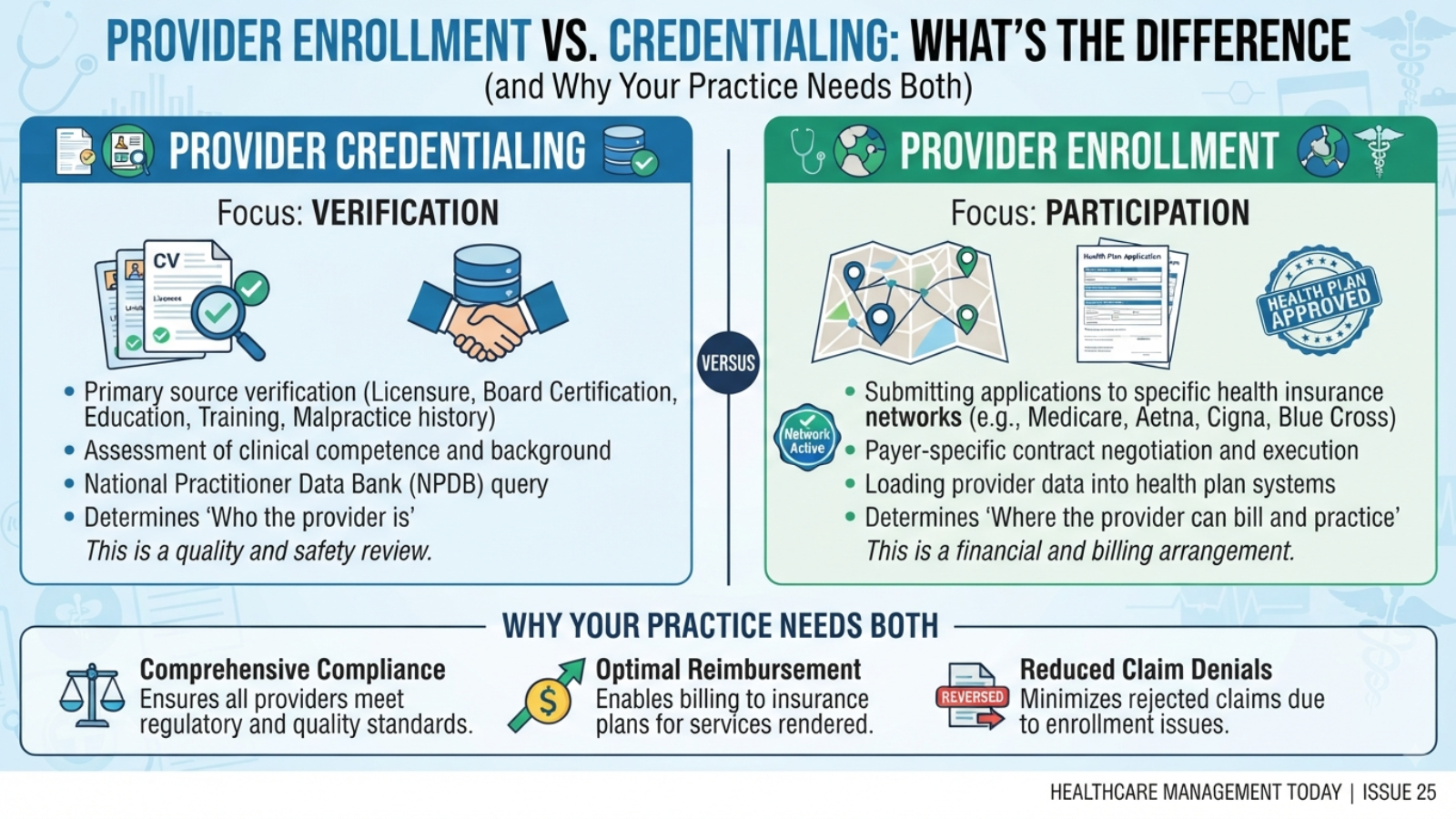
A provider is credentialed. A provider is enrolled. A billing team says a claim was denied because “enrollment isn’t finished,” while the credentialing file shows the provider was approved months ago. If that combination of facts is confusing, it’s because credentialing and provider enrollment are two distinct processes that get used interchangeably in everyday conversation — and that confusion is exactly what causes preventable claim denials.
Here’s the direct answer: credentialing verifies who a provider is and whether they’re qualified to practice; enrollment is the administrative process of registering that provider with a specific payer’s billing system so claims can actually be paid. A provider can be fully credentialed and still be unable to bill because enrollment isn’t complete. This article walks through exactly where the line falls, how the two processes connect, and what happens when practices treat them as the same step.
Credentialing: Verifying Qualifications
Credentialing is a verification process. A payer’s credentialing committee (or a delegated credentialing entity) reviews a provider’s:
- Education and training history
- State medical license status and history
- Board certifications
- Malpractice insurance coverage and claims history
- Work history, with any gaps explained
- Sanctions, exclusions, or disciplinary actions
- DEA registration, where applicable
The goal is a yes/no decision: does this provider meet the payer’s standards to participate in the network at all? Most commercial payers pull this data through a CAQH ProView profile, which centralizes the same core information for reuse across multiple payers rather than requiring a provider to submit it separately each time.
Credentialing answers the question: Is this provider qualified and in good standing?
Enrollment: Getting Added to the Billing System
Enrollment is what happens after — or sometimes alongside — credentialing. It’s the administrative step of registering a provider in a specific payer’s system so that claims submitted under that provider’s NPI are recognized, processed, and paid rather than automatically rejected.
The clearest example is Medicare. Medicare enrollment happens through PECOS — the Provider Enrollment, Chain and Ownership System — a CMS platform separate from any commercial credentialing process. Enrollment through PECOS uses CMS-855 forms specific to the situation:
- CMS-855I — individual providers
- CMS-855B — clinics, group practices, and other organizational suppliers
- CMS-855R — reassignment of benefits (joining a group)
PECOS doesn’t evaluate whether a provider is clinically qualified — that’s what state licensure and, separately, credentialing establish. PECOS confirms identity, tax and ownership information, practice locations, and banking details so CMS knows exactly who is billing, under what tax ID, and where payments should go. An application can be submitted correctly and still be rejected over a mismatched detail as small as an NPI record that doesn’t match the legal name on file.
Enrollment answers the question: Is this provider correctly registered in this payer’s billing system?
How the Two Processes Actually Connect
| Credentialing | Enrollment | |
|---|---|---|
| What it verifies | Provider qualifications, licensure, training, history | Administrative billing registration |
| Who manages it | Payer credentialing committees (commercial); state boards | CMS via PECOS (Medicare); state Medicaid agencies; payer enrollment teams |
| Primary data source | CAQH ProView (commercial) | CMS-855 forms; NPPES/NPI registry; state Medicaid portals |
| Typical timeline | 90–120 days (commercial) | 60–90 days (Medicare PECOS) |
| Outcome | Approved to participate in network | Able to bill and be reimbursed |
For Medicare specifically, a provider generally needs both processes to align: credentialing-equivalent verification through licensure and training standards, and PECOS enrollment to actually bill. For commercial payers, credentialing and enrollment are sometimes handled by the same team in close sequence, which is part of why the two terms get blurred in daily use — but a credentialing approval and a fully loaded, billable enrollment record are still two separate outcomes, and a gap between them is a common, quiet cause of denied claims. For a full look at how long each stage of this process actually takes, see How Long Does Provider Credentialing Take?
Where the Confusion Causes Real Problems
The practical risk isn’t academic. When credentialing and enrollment are treated as the same step:
- Claims get submitted before enrollment is actually complete, resulting in denials even though the provider was “approved” weeks earlier.
- Data mismatches between the credentialing file and the enrollment application — a different practice address, a name variant, an NPI typo — trigger delays that could have been caught if the two processes were tracked together.
- Revalidation deadlines get missed. Medicare enrollment requires periodic revalidation (generally every five years), which is separate from the CAQH 120-day attestation cycle and the payer’s own recredentialing schedule. Missing any one of these three clocks can quietly interrupt billing.
- Group additions stall. When a new provider joins an existing group, reassignment of benefits (CMS-855R) has to be filed correctly alongside the individual enrollment — a step that’s easy to overlook if credentialing is treated as the finish line.
A Practical Way to Think About the Sequence
For most new providers, the realistic order looks like this:
- State licensure confirmed and active
- CAQH profile built and attested
- Credentialing submitted to and approved by relevant commercial payers
- Medicare enrollment submitted via PECOS (can run in parallel with commercial credentialing, not after it)
- Medicaid enrollment submitted to relevant state program(s)
- Contracting — rates and terms finalized once credentialing/enrollment clears, covered in more detail in our guide to negotiating payer contract rates
- Billing goes live only once enrollment records are fully loaded on the payer’s side, not simply once a credentialing decision letter arrives
Steps 3 and 4 can and should run concurrently rather than sequentially — one of the most common, avoidable sources of lost time is waiting to start Medicare enrollment until commercial credentialing is finished, when the two have no dependency on each other.
Why Practices Need Both, Managed Together
Treating credentialing and enrollment as one continuous, jointly tracked process — rather than two separate tasks handled by whoever has time — is what actually prevents the claim denials and billing gaps that show up months later, disconnected from their real cause. This is where dedicated business consulting for healthcare providers matters as much as the credentialing paperwork itself: getting the sequencing right the first time avoids a second round of corrections after a practice is already seeing patients.
Red Sea Consulting handles credentialing and enrollment as a coordinated process rather than disconnected paperwork, with dedicated account management tracking both sets of deadlines — CAQH attestation, payer credentialing status, and PECOS enrollment — so nothing falls into the gap between “approved” and “billable.”
Have a provider stuck between “approved” and “billable”? Book a consultation and we’ll find out exactly where the gap is.
FAQ: Provider Enrollment vs. Credentialing
Is provider enrollment the same as being in-network? Not exactly. Enrollment registers a provider in a payer’s billing system; being fully in-network also typically requires an executed contract at agreed rates. A provider can be enrolled and credentialed while contract terms are still being finalized.
Do I need to complete credentialing before starting Medicare enrollment? No — Medicare enrollment through PECOS and commercial payer credentialing are independent processes and can be submitted in parallel to save time.
What is PECOS used for? PECOS (Provider Enrollment, Chain, and Ownership System) is the CMS platform used to enroll, update, and revalidate Medicare provider and supplier records. It manages billing registration, not clinical credentialing.
How often does Medicare enrollment need to be revalidated? CMS generally requires revalidation on a set cycle, commonly around every five years, separate from CAQH’s 120-day attestation requirement and a commercial payer’s own recredentialing schedule.
Can a claim be denied even if a provider is credentialed? Yes. A common cause is a claim submitted before enrollment with that specific payer is fully processed and loaded, even though credentialing was approved.
What happens when a provider joins an existing group practice? In addition to standard credentialing, a reassignment of benefits form (CMS-855R for Medicare) generally needs to be filed so claims can be billed under the group’s tax ID rather than only the individual provider.
Who manages provider enrollment — the practice or the payer? The provider or practice submits and manages the enrollment application; the payer (or CMS, for Medicare) reviews and processes it. Responsibility for accuracy stays with the submitting provider or authorized official even when a third party assists.
This portal handles everything smoothly from account setup to cash out. Local banking options work perfectly and the customer reps are incredibly helpful. I feel confident playing here every single day phbetso888