
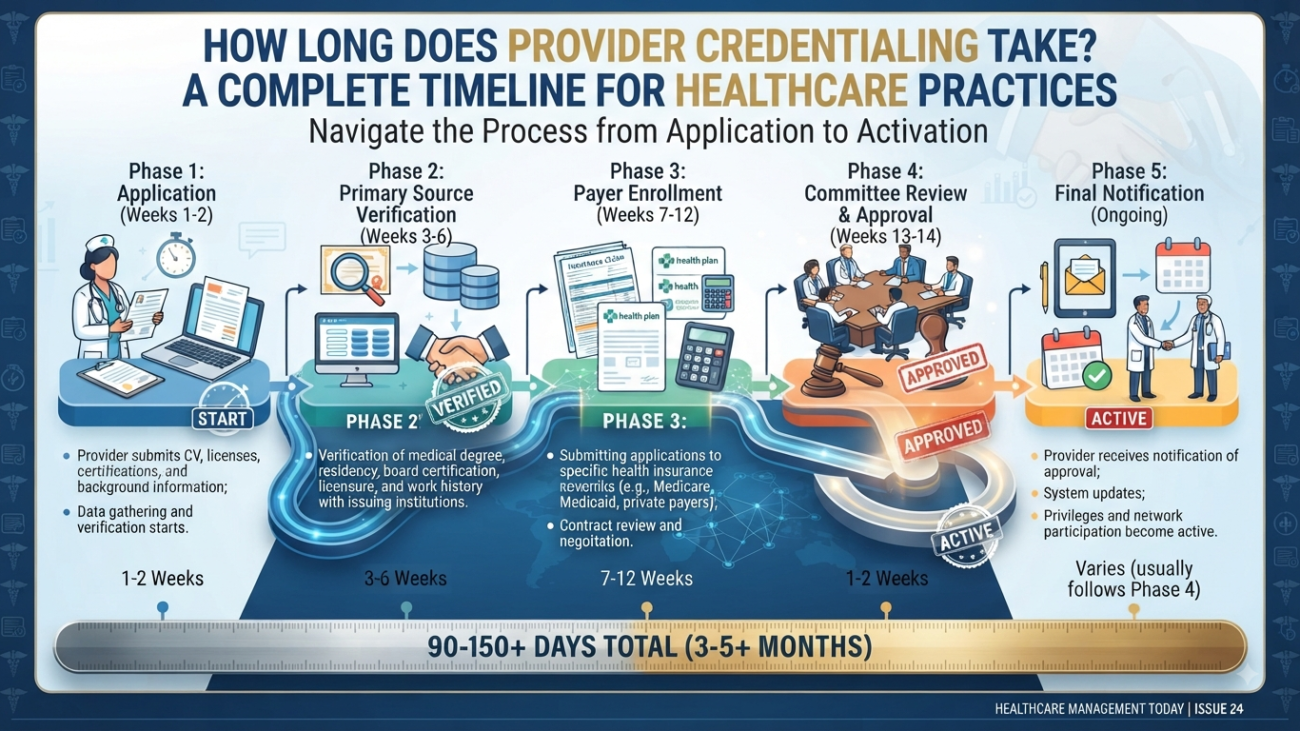
If you’re opening a new practice, hiring a provider, or adding a location, the question that determines everything else is simple: how long until this provider can actually see patients and get paid? The honest answer is that credentialing takes anywhere from 60 to 180 days depending on the payer, and treating it as a single, uniform process is the single biggest reason practices miss their planned launch dates.
This guide breaks down exactly how long each stage takes, why timelines differ so much between Medicare, Medicaid, and commercial payers, and what actually causes the delays that turn a 90-day estimate into a six-month wait.
What Is Credentialing, Exactly?
Credentialing is the verification process payers use to confirm that a provider is who they say they are — that their license is active, their education and training check out, their malpractice history is clean, and they meet the payer’s participation standards. It happens before a provider can be added to a payer’s network and before claims for that provider can be reimbursed.
Credentialing is not the same as contracting (negotiating the rates and terms once approved) or enrollment (the administrative step of being added to a payer’s billing system, most visible with Medicare’s PECOS system). The three are sequential and often confused, which is part of why timeline expectations get muddled. For a full breakdown of how enrollment and credentialing relate, see our companion article, Provider Enrollment vs. Credentialing: What’s the Difference.
The Credentialing Timeline, Stage by Stage
Stage 1: CAQH Profile Setup (1–3 hours of work, 3–10 business days to activate)
Most commercial payers pull provider data from CAQH ProView, a centralized data repository maintained by the Council for Affordable Quality Healthcare. Building a CAQH profile from scratch — entering education history, work history, licenses, malpractice coverage, and practice locations — typically takes a provider or credentialing staff member one to three focused hours, assuming documents are already gathered. Once submitted and attested, the profile itself is generally active within about a week.
The catch: a completed CAQH profile is a prerequisite for credentialing, not the credentialing decision itself. Payers still have to pull that data and run their own review.
Stage 2: Commercial Payer Credentialing (90–120 days)
Once a payer has access to a complete, attested CAQH profile, the credentialing committee review typically runs 90 to 120 days from submission to decision. This is the stage most people mean when they ask how long credentialing takes, and it’s also the stage most vulnerable to delay — a single missing document, an expired certificate, or a mismatch between the CAQH profile and the payer application can send an application back to the bottom of the queue.
Stage 3: Medicare Enrollment via PECOS (60–90 days)
Medicare enrollment runs through PECOS — the Provider Enrollment, Chain, and Ownership System — a separate process from commercial credentialing, submitted through CMS-855 forms specific to individuals, groups, or benefit reassignment. Processing generally takes 60 to 90 days from a complete submission, though the exact timeline depends on the Medicare Administrative Contractor (MAC) assigned to your region. Missing NPI details, ownership disclosures, or signature mismatches are common causes of “development letters” that restart the clock.
Stage 4: Medicaid Enrollment (30–120 days, highly state-dependent)
Medicaid enrollment is the least predictable stage because every state runs its own program, its own portal, and its own review standards. Some states process applications in as little as 30 days; others routinely take 120 days or more, particularly for out-of-state or newly licensed providers. If your practice operates in multiple states, plan for the slowest state in your footprint to set your realistic go-live date.
Stage 5: Payer-Specific Contracting
Being credentialed doesn’t automatically mean you’re in-network. Some payers credential and load a contract simultaneously; others require a separate contracting step once credentialing clears, which can add several more weeks before the provider is billable at negotiated rates. This is where many practices lose time they didn’t budget for — see our guide, How to Negotiate Higher Payer Contract Rates, for what that stage actually involves.
Realistic Total Timeline: What to Actually Plan For
| Payer Type | Typical Processing Time | Key Dependency |
|---|---|---|
| Commercial (via CAQH) | 90–120 days | Complete, attested CAQH profile |
| Medicare (PECOS) | 60–90 days | Accurate CMS-855 application, NPI match |
| Medicaid | 30–120 days | State-specific, highly variable |
| Contracting (post-credentialing) | 2–8 additional weeks | Separate from credentialing in many cases |
For a provider credentialing with a full mix of commercial, Medicare, and Medicaid payers, a 120-to-150-day runway from application submission to full in-network billing status is a realistic planning assumption — not the 30-day timeline sometimes advertised, and not the worst-case six-month horror story either, if the application is clean from the start.
Why Credentialing Takes Longer Than Expected: The Real Causes of Delay
Most delays aren’t about payer slowness. They’re about avoidable errors on the front end:
- Incomplete CAQH profiles. A profile that’s unattested, missing a work history gap explanation, or lacking a required document gets flagged before a payer even begins substantive review.
- Data mismatches. A provider’s name, NPI, or practice address that doesn’t match exactly across CAQH, the state license, and the payer application is one of the most common reasons applications stall.
- Expired documents. DEA registrations, board certifications, and malpractice coverage all have renewal cycles. An application submitted against an expiring document gets held for updated proof.
- Re-attestation lapses. CAQH requires attestation every 120 days. A lapsed attestation can freeze credentialing that’s already in progress.
- No dedicated follow-up. Payer credentialing queues move faster for applications that get proactive status checks and quick responses to information requests — and slower for applications nobody is tracking.
How to Shorten Your Credentialing Timeline
- Gather documents before you start. Licenses, DEA registration, malpractice face sheet, CV with no unexplained gaps, board certification, and W-9 should all be ready and current before the CAQH profile is built.
- Build the CAQH profile first, and attest immediately. Don’t wait for a specific payer application to start this — CAQH access is required by nearly every commercial payer.
- Submit Medicare and Medicaid applications in parallel with commercial applications, not after. These run on separate, independent clocks, so sequencing them saves real calendar time.
- Track every application status weekly. Payers rarely proactively notify practices of missing items; someone needs to be checking and responding fast.
- Set a re-attestation calendar reminder for every 120 days, permanently, so an active credential never lapses due to a missed CAQH deadline.
When It Makes Sense to Outsource Credentialing
Practices that handle credentialing internally often underestimate the ongoing time commitment — not just the initial application, but the continuous status tracking, re-attestation, and follow-up that keeps applications moving instead of stalling in a queue. For a solo provider, that might be manageable. For a group adding several providers across multiple states and payer types, it becomes a full administrative function on its own.
Red Sea Consulting manages the credentialing process end-to-end nationwide — application preparation, document verification, and the ongoing follow-up that keeps applications from sitting untouched in a payer’s backlog. Our credentialing services team also stays current on payer-specific requirements through dedicated research and development tracking of policy and payer updates, so applications go in clean the first time.
Ready to see how much time a coordinated process could save your practice? Book a consultation with our credentialing team.
FAQ: Provider Credentialing Timelines
How long does it take to get credentialed with a new insurance company? For most commercial payers, expect 90 to 120 days from a complete application submission to a credentialing decision, assuming no missing documents or data mismatches.
Can credentialing be expedited? Some payers offer limited expedited review for specific circumstances, but there’s no universal fast-track. The most reliable way to shorten the timeline is submitting a complete, error-free application and following up proactively rather than waiting for payer-initiated updates.
Does CAQH credential me automatically? No. CAQH is a data repository, not a credentialing decision-maker. Payers pull your CAQH data as part of their own independent credentialing review.
Why is my Medicaid enrollment taking longer than my commercial credentialing? Medicaid enrollment timelines vary by state and are managed through separate state portals, independent of CAQH and commercial payer processes. Some states process in 30 days; others take 120 days or more.
Can I see patients before credentialing is complete? Seeing a patient and getting reimbursed for that visit are separate questions. Providing care before credentialing finalizes typically means claims for that period can’t be billed to the payer retroactively unless the payer’s specific policy allows backdated effective dates — which varies significantly by payer.
What’s the difference between credentialing and being “in-network”? Credentialing verifies a provider meets a payer’s standards. Being in-network additionally requires a signed, active contract with that payer at agreed rates. A provider can be credentialed and still be waiting on contract execution before they’re billable in-network.
How often do I need to re-credential? Most payers require recredentialing every 36 months, alongside the CAQH 120-day attestation cycle that keeps underlying data current in between full recredentialing cycles.